
 Tyler Bates
Priapic Throb & Unmuffled Exhaust
published in The Wire online, June, 2026, London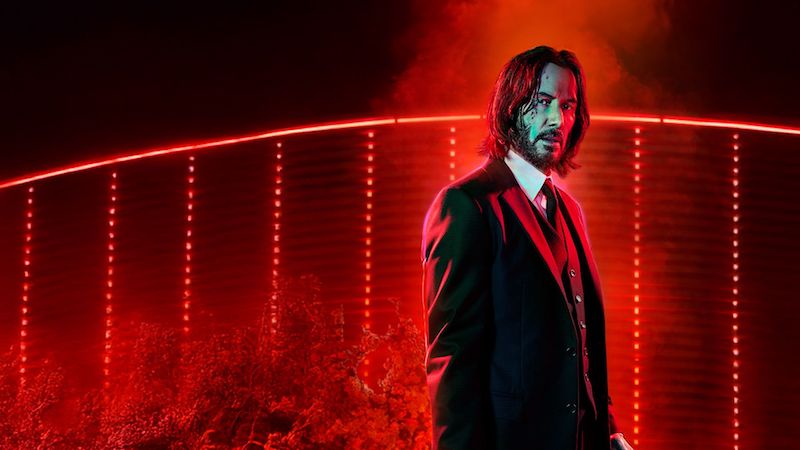
In 2014, Tyler Bates became the principle guitarist in Marilyn Manson, some fifteen years after the group was formed. By that stage, he had well established himself as a film composer through strong relationships with Zack Snyder, Rob Zombie and James Gunn across the preceding decade. While attracting sizable pools of haters and worshippers, those three directors reflect 21st century quotative media practices, initiated earlier by Quentin Tarantino’s snarling cinephilia revisions and Frank Miller’s dark rewriting of comic book mythologies. Yet while Reservoir Dogs (1992) and The Dark Knight Returns (1986) bare their nerdy disposition, movies like Snyder’s Dawn of the Dead (2004), Zombie’s The Devil’s Rejects (2005) and Gunn’s Slither (2006) feel desperate to not be assumed nerdy. Tyler Bates’ guitar-brandishing smack-downs are a key ingredient in this generic slipstream of macho actioner scoring. It might be an imitative practice, but its predominance gives cause to musicologically reflect on its spread.
The score Bates (in collaboration with Joel J. Richard) delivered for Chad Stahelski and David Leitch’s John Wick (2014) is a sonic marker of this muscular approach to film scoring. John Wick was the first film developed and produced by Stahelski and Leitch’s stunt company 87Eleven, which since 1997 had been providing stunt choreography, supervision and execution for bloodied movies like Blade (1998), Fight Club (1999), Ghosts of Mars (2001) and Van Helsing (2004). It’s easy for cultured elites like myself to mock stunt-centric films, but these and many more 87Eleven contracts featuring Leitch himself as a stunt performer contain stellar moments of physical prowess and balletic violence. I say this in a column on film music because most ‘departments’ in filmmaking are often engaged in the frustrating work of proving their craft on the screen. The film score is renowned for being thwarted, reduced, stymied and supressed in a film’s final mix; the performative role of stunt work functions similarly. By the time Leitch had directed Atomic Blonde (2017, also scored by Bates) and Bullet Train (2022), he was able to demonstrate how the raw and brute physicality of an actor’s performance (Charlize Theron and Brad Pitt, respectively) could be accented in the sensorial delivery of a movie predicated on bodily mechanics. John Wick was 87Eleven’s announcement of this cine-bodied proof-of-concept, one that intersected with Tyler Bates’ orchestrated blasts of chugging rock.

In John Wick, the core melodic theme “Story of Wick” slowly unfurls a single note every eight beats or so. It’s metronomic and impassive, played by a flamenco guitar like a tense Cinecitta showdown. It returns in a fortified wall of Dick Dale fuzz rewired through God Speed You Black Emperor reverb. A touch derivative, but a roaringly compacted track that essays Keanu Reeve’s ‘Zen gun’ demeanour. Other pieces like “Lure The Wolf” and “Assassins” sheen like a Formica replication of GGGarth and Melvins’ sound for Stoner’s Witch (1992). These cues capture the vicious explosions of rage each time various hitman battle with Wick, the ur-hitman. In this respect, Bates/Richard’s overload of aggressive sonics is an American counterpoint to the mannered silence which frames Alain Delon’s presence throughout much of Jean Pierre Melville’s definitive hitman opus, Le Samouraï (1967).
Throughout John Wick, pulsing synthesizers are judiciously employed; electronic pads of pseudo-choral affect are draped over guitar textures without smothering them. The pendants “Baba Yaga” and “On The Hunt” demonstrate this well, transmuting the core theme into a fractured balalaika motif, laced with fuzzed bass synths and a soft volcanic ripple which sounds like the amp speakers Link Wray tore with a pencil in order to create his crispy fluttering noise. These sizzling aspects of Bates/Richard’s score lean into the unleashed monster created by messing with John Wick (by stealing his 1969 Mustang and killing his Beagle puppy). Incensed and traumatized by those incidents, Keanu’s dialogue is elliptical and inexpressive, reading more like plot scene tags than anything to do with character motivation — because Wick is not merely a ‘man of action’, but ‘action personified’. The focus on stunts is crucial to this project, and Bates/Richard’s score adheres to this ruthlessly.
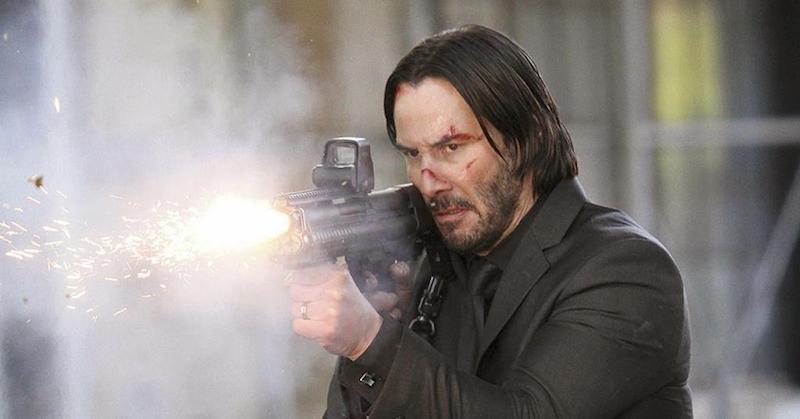
Stahelski’s John Wick: Chapter 2 (2017) replicates the musical traits of the first film, interestingly foregrounding the bass guitar. Notable aural semiotics arise. Funk recreated the bass guitar as priapic pounding (thanks to Bootsy Collins, Larry Graham, Bernard Edwards, Louis Johnson, et al). Classic rock bassists arguably avoided the miscegenational implications of ‘funking’, while post-Punk bassists embraced its bottom end power (courtesy of the bushido punch of Jean Jacques Burnell and the New Wave Bootsyisms of Barry Adamson). Since 1990s multi-genre merger mania, it has been hard to find a hard rock or industrial rock group who didn’t foreground the bass as much as their guitars. Nowadays, it’s equally hard to find action movies that don’t trade in the type if ‘cine-djent’ developed and defined by Bates across many movies.
In John Wick 2, both “Man of Focus” and “Sumo Showdown” revise “Story of Wick” into phallic slapping, full of sonic punches, belts, jabs and thrusts. Yes, it’s all a bit much, but worth noting is how the Wick franchise from this point dances upon the tightrope of successful sequelization. Impotent film producers getting hard by financing actioner fodder are most responsible for the Viagra-pilled drive of contemporary Hollywood action fare. Under such economics, the score is bound to comply for its survival. Yet Bates/Richard deliver what might be the best score for the Wick quadrology. Their work for Stahelski’s John Wick: Chapter 3 (2019) and John Wick: Chapter 4 (2023) introduce more atmospheric tonalities and layerings while still riffing with the core theme, glorifying Wick’s nihilistic heroism with roaring strings, buzzing synth tones and pleasingly tuned feedback ringing.
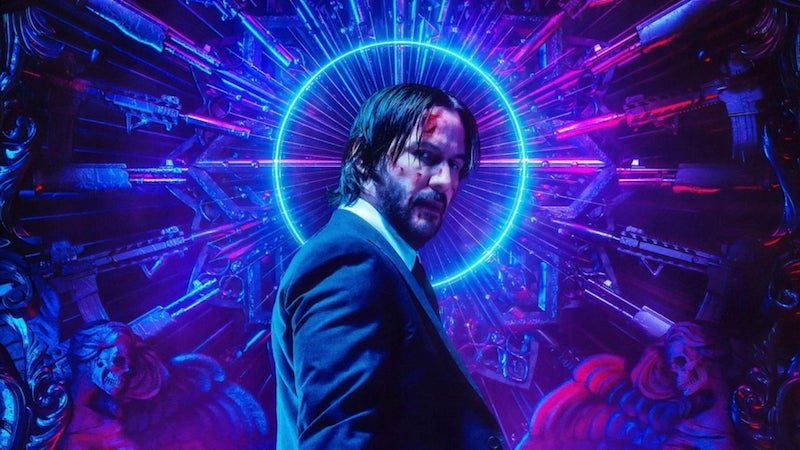
Maybe those with an interest in ‘serious’ film music care less for the subtleties of these four scores. I admit to perversely enjoying bloated Hollywood histrionics in flaccid macho actioners, however that pleasure is ultimately a nasty one. I’m more stimulated by the challenge to find some merit or value amidst the disreputable borders of cinema and music. The scores by Tyler Bates have functioned as barometers, divining a vein of creative energy (macho, yes) which charts how music can, in a sense, embody physicality. And yes, Bates’ results have been copied in countless super-hetero male-ific movies which instate his approach as a type of UFC cinerock that rumbles and throttles like unmuffled car exhausts. We get: slow thudding drums mimicking John Bonham, but never matching his prowess (audible in countless live recordings of “Moby Dick”); a near-masturbatory use of timpani, toms, kicks and taiko from industry sample companies like Spitfire Audio, Orchestral Tools and Cinesamples; and single strums of fuzzed chords that one could hear in any suburban guitar shop on a Friday night.
As per the consumptive logic of sequelization, the Wick metaverse offshoot of Len Wiseman’s Ballerina (2025) stretches everything to a point of quantum looping, bending time and space back upon itself — here further ‘bent’ through gender-swapping its avenging angel into Eve (Ana de Armas, who performed many of her own stunts in single shots). Musically, this involves a generative matrixing of elements from the previous four films’ cues and textures. The Bates/Richard’s score is folded into its own history, channelled onto the screen as a coded sequence that unfortunately does little to enhance the film’s bullet ballet and gun play. Rather, it is mapped at a meta level external to the film’s visceral dynamics. The cues are structured and sequenced in an endless parade of stop/start, loud/soft, still/fast gestures. The music is always in Black Ops mode: signalling stealth, evasion, camouflage, attack and rage. But even though the non-stop engine idling of Ballerina’s score is irritating, it is determined by the current steroidal state of action movies, where bodies are thrust loudly into the eyes of the audience.
Text © Philip Brophy 2026. Images © Lionsgate Studios
hyper material for our very brain

All contents © Philip Brophy with great pain of taking.
Please accept offensive behaviour.
We have safety but for children.